GregorHagedorn - Mon Dec 13 2004 - Version 1.8
Parent topic: LinneanCoreCanonicalAuthorship
1 Probably an oversight:
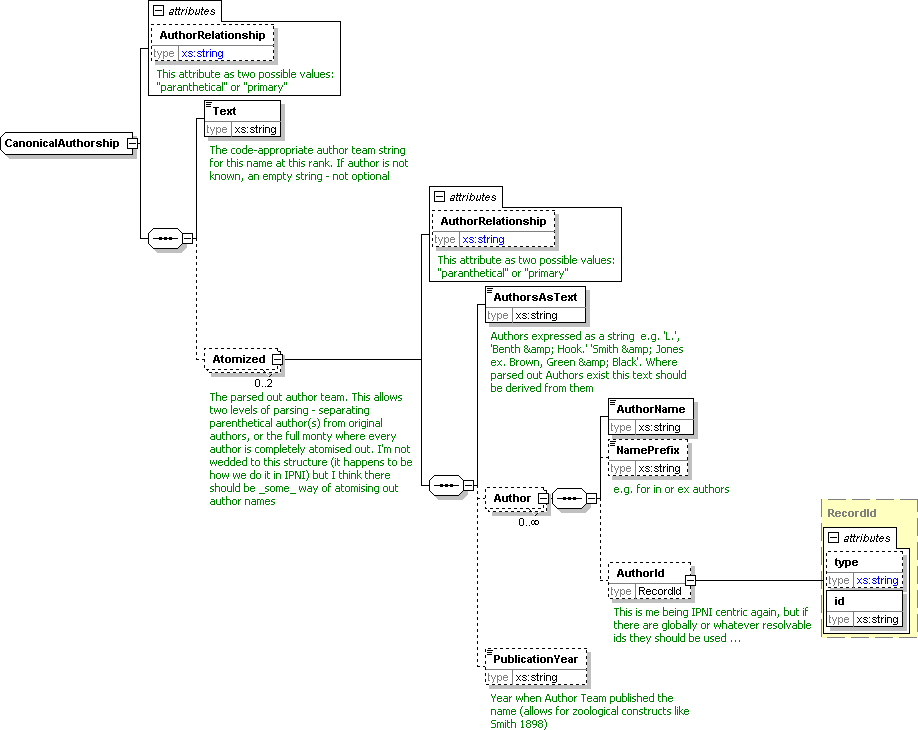
Sally writes in the schema: "The parsed out author team. This allows two levels of parsing - separating parenthetical author(s) from original authors, or the full monty where every author is completely atomised out. I'm not wedded to this structure (it happens to be how we do it in IPNI) but I think there should be some way of atomising out author names".
I think, it would easier to express this through two element names. This is not logical necessity, just preference because I believe this is easier seen-through when mapping from flat-file data.
Secondly, I wonder whether to equate "non-parenthetical" with "primary" makes sense (as implied in opposing "parenthetical" with "primary"). In botany I rather think of the parenthetical author (= basionym-author) as the primary author. For the moment I propose to replace the two types with Protonym and Combining citation, following the original usage by Jerry Cooper in the first LC draft. 4 A bit of a problem is the case of "ex" and ":" (= sanctioning in fungi) citations. This must be nested within the Protonym and Combining structure - and then within those each list of authors must have multiple authors. Sally's proposal adding a prefix to the first author of the team that needs to be marked with an ":" or "ex"could work. It seems a bit odd that a prefix that belongs to a multi-author team should be tied to the first, but I certainly do not like the alternative of providing another structural layer as well. Just for the sake of variety, I propose to recognize ":" and "ex" as special values and simply treat them in the authors list. Not sure which is more elegant!
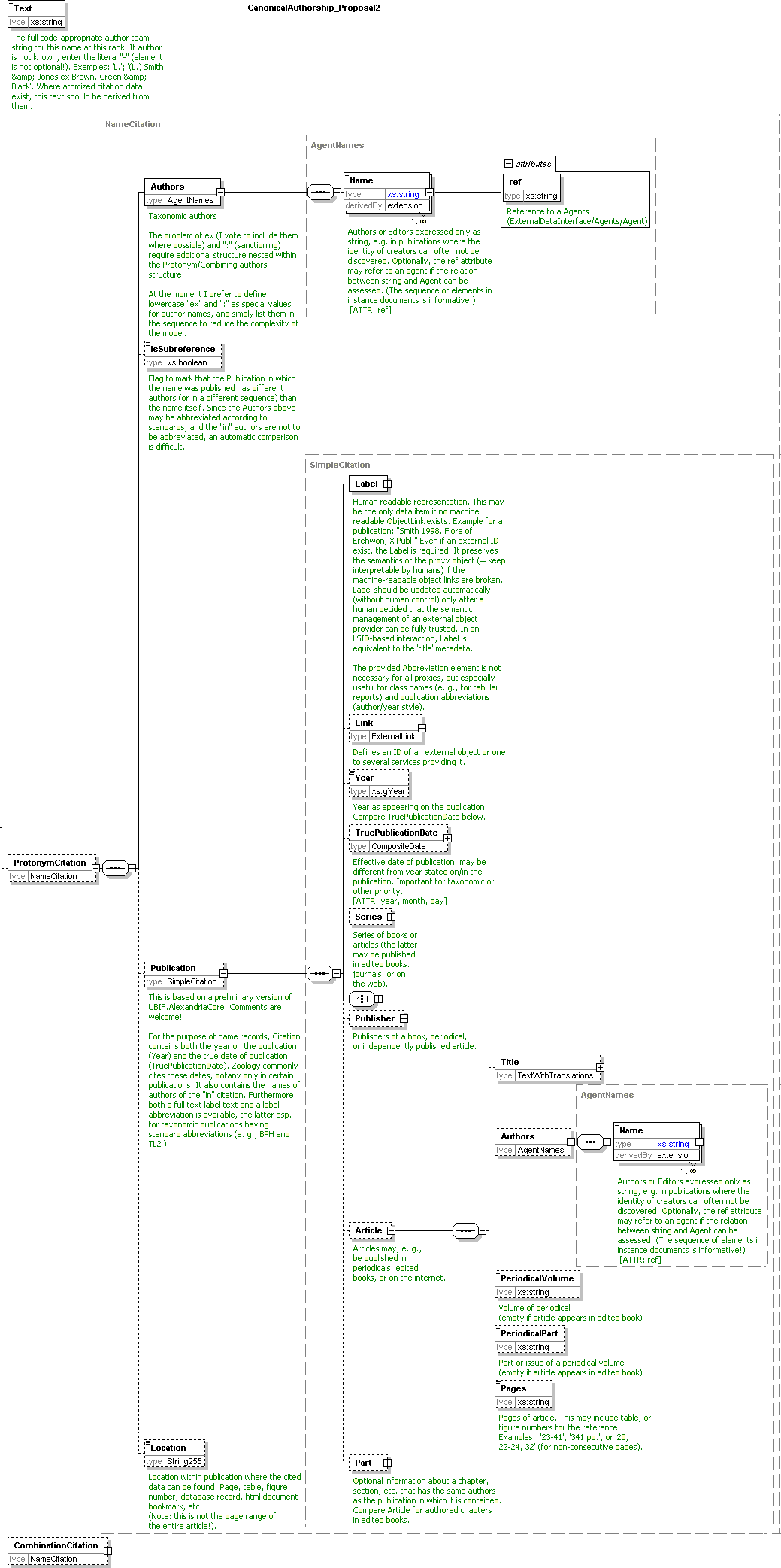
Note that in version 0.1.4 I have inserted into LC a preliminary version of the not-yet-really existing "Alexandria core". The Citation elements handle the "in" authorsComments on that are most welcome - this is kind of the first community who might care.
To facilitate the discussion, I attach two schema diagrams. Note that the Proposal 2 is much longer because it shows selected details of the publication / reference system of Alexandria core, to make clear where year, in-authors etc. may end up.
-- Main.GregorHagedorn - 08 Nov 2004
Gregor: I think in Proposal 2 the Protonym/Combining citation structure does not work for zoology yet. In botany, if a name is not an original name or a nomen novum, i.e. if the name is recombined, the combining author can be expected to be known. Consequently, the distinginction between rendering "Genus species
Sally: I'm not against this proposal. Some examples would be helpful, particularly of zoological names, and also some of the more complicated author strings (in and ex authors or the fungal equivalents). Our guiding principle should be that there's enough structure to prevent nonsense, but enough simplicity to make the structure readable to the naked eye - so having explicit container names (protonym or combining citation structures) helps with this. For consistency, should the 'Text' element actually be 'Label' - as we have done for the name itself? Main.SallyHinchcliffe - 09 Nov 2004
Rich (from email): Maybe
Rich (from email, continued): Also on this topic, I would prefer to embrace the "authors of Publications, rather than names" approach completely, and change "CanonicalAuthorship" to "SourcePublications" -- of which there may be two (Protonym & Combination; the latter optional). - 09 Nov 2004
Another problem I just notice: although in AlexandriaCore it is desirable that the Label of the reference exists, this is probably impossible for the embedded AC part in the citation. You may know the publication year or true publication date, but nothing more. - Gregor - 9 Nov 2004
Original Proposal 1 (vers. 0.1.3 = schema 2c):
<CanonicalAuthorship>
  <Text>Vell.</Text>
  <Atomized AuthorRelationship="Primary">
	 <AuthorsAsText>Vell.</AuthorsAsText>
	 <Author>
		<AuthorName>Vell.</AuthorName>
	 </Author>
  </Atomized>
</CanonicalAuthorship>
Alternative Proposal 2 (= see in ver. 0.1.4):
<CanonicalAuthorship>
  <Text>Vell.</Text>
  <ProtonymCitation>
	 <Authors><!-- no equivalent to unparsed AuthorsAsText from Proposal 1! -->
		<Name>Vell.</Name>
	 </Authors>
  </ProtonymCitation>
</CanonicalAuthorship>
For a complex example I use the artificial "Genus species (A. Invalid & B. Publication ex A. Protonym-Author1 & B. Author2) D.I.D. Recombination & T.O. Gether-With (1999 [2000])". Note: examples are handwritten and may contain errors.
Original Proposal 1 (vers. 0.1.3 = schema 2c):
<CanonicalAuthorship>
<Text>(A. Invalid & B. Publication ex A. Protonym-Author1 & B. Author2) D.I.D. Recombination & T.O. Gether-With (1999 [2000])</Text>
<Atomized AuthorRelationship="Parenthetical">
<AuthorsAsText>A. Invalid & B. Publication ex A. Protonym-Author1 & B. Author2</AuthorsAsText>
<Author>
<AuthorName>A. Invalid</AuthorName>
</Author>
<Author>
<AuthorName>B. Publication</AuthorName>
</Author>
<Author>
<AuthorName>A. Protonym-Author1</AuthorName>
<NamePrevix>ex</AuthorName>
</Author>
<Author>
<AuthorName>B. Author2</AuthorName>
</Author>
</Atomized>
<Atomized AuthorRelationship="Primary">
<AuthorsAsText>D.I.D. Recombination & T.O. Gether-With</AuthorsAsText>
<Author>
<AuthorName>D.I.D. Recombination</AuthorName>
</Author>
<Author>
<AuthorName>T.O. Gether-With</AuthorName>
</Author>
<PublicationYear>1999 [2000]</PublicationYear>
</Atomized>
</CanonicalAuthorship>
Alternative Proposal 2 (= see in ver. 0.1.4):
<CanonicalAuthorship>
<Text>(A. Invalid & B. Publication ex A. Protonym-Author1 & B. Author2) D.I.D. Recombination & T.O. Gether-With (1999 [2000])</Text>
<ProtonymCitation>
<Authors>
<Name>A. Invalid</Name>
<Name>B. Publication</Name>
<Name>A. Protonym-Author1</Name>
<Name>ex</Name>
<Name>B. Author2</Name>
</Authors>
</ProtonymCitation>
<CombinationCitation>
<Authors>
<Name>D.I.D. Recombination</Name>
<Name>T.O. Gether-With</Name>
</Authors>
<Publication><!-- note: title, etc. may be given here as well -->
<Year>1999</Year>
<TruePublicationDate year="1999"/><!-- optionally also month, day -->
</Publication>
</CombinationCitation>
</CanonicalAuthorship>
Please do comment or correct. Maybe someone would like to create an even more complex real example, involving "in" citation and publication details, including protologue/original description page?
-- Gregor Hagedorn, 9. Nov. 2004